Before You Replace Your Nonprofit CRM, Fix the Process Behind It
Nonprofit organizations often come to us convinced they have reached the same conclusion: Their CRM cannot do what they need it to do.
Sometimes they are right. A platform may genuinely be outdated, poorly suited to the organization or unable to support its evolving needs. But after hundreds of discovery sessions, technology audits and platform-selection projects, we have learned that the CRM is frequently not the first thing that needs replacing.
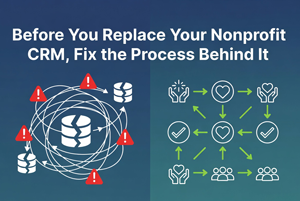
The more immediate problem is often the collection of inconsistent processes, unclear responsibilities and disconnected workarounds that have developed around it.
Replacing the technology without addressing those issues rarely solves the problem. It simply moves the same operational challenges into a newer—and often more expensive—system.
The CRM Becomes the Villain
By the time Cathexis Partners is invited into an organization, staff members may have been frustrated for months or even years. Reporting takes days instead of minutes. Teams maintain their own versions of the same information. Development blames marketing, marketing blames finance and leadership blames the CRM.
The software becomes the villain because it is the most visible part of the problem. Yet a CRM can only support the processes an organization has defined and consistently follows. If no one agrees on how a constituent should be entered, who owns the relationship or when information should be updated, technology cannot make those decisions on the organization’s behalf.
That is why a productive CRM assessment should begin with people and process—not a list of competing products.
Look for the Hidden Spreadsheet Economy
One of the clearest warning signs is not found inside the CRM at all. It is the collection of spreadsheets surrounding it.
Every nonprofit uses spreadsheets, and there is nothing inherently wrong with that. The problem begins when spreadsheets become business-critical systems for managing:
- Event registrations
- Pledges and payments
- Volunteer assignments
- Grant deadlines
- Major-gift portfolios
- Sponsorships and corporate relationships
- Email preferences
- Board and committee engagement
Each spreadsheet may solve an immediate problem for one person or department. Collectively, however, they create competing sources of truth. Information is copied, reformatted and re-entered. Updates made in one place do not reach another. Reporting depends on whoever understands the latest version of the file.
This “hidden spreadsheet economy” is often blamed on the CRM. In reality, it usually points to a process that was never clearly defined, a system that was not fully configured or adopted, or an integration that was never established.
Start With the Work, Not the Software
Before evaluating replacement platforms, we encourage organizations to map how work actually gets done today. That means documenting the real process—including the unofficial steps and workarounds—not merely the process described in an old procedure manual.
For each critical workflow, ask:
- What triggers the process?
- Who is responsible for each step?
- What information is collected, and where?
- Which decisions or approvals are required?
- Where is information re-entered or manually transferred?
- Where do delays, errors or confusion most often occur?
- What reporting is needed at the end?
These questions frequently reveal that what appeared to be a technology limitation is really an ownership gap, inconsistent data entry, missing training or a workflow that grew informally over time.
The exercise also helps distinguish among three very different situations:
- The current CRM can support the organization’s needs but requires better processes, configuration, training or governance.
- The CRM can support some needs, but complementary tools or integrations are required.
- The organization has genuinely outgrown the platform and should evaluate alternatives.
That distinction can prevent an organization from spending significant time and money solving the wrong problem.
A New CRM Will Not Clean Up Old Ambiguity
There is a tempting belief that a new platform will force everyone to work consistently. Usually, the opposite happens. During implementation, every unresolved question becomes a configuration decision:
- What constitutes a household?
- Who owns data quality?
- Which system is the source of truth for each type of information?
- How are duplicate records handled?
- What counts toward fundraising revenue?
- Who can change constituent preferences?
- Which reports and metrics should leadership trust?
If those decisions are not made before or during implementation, the new system inherits the ambiguity of the old one. Staff members recreate familiar workarounds, spreadsheets return and confidence in the new CRM begins to erode.
Technology can reinforce a strong process. It cannot create agreement where none exists.
When Replacement Is the Right Answer
None of this means a nonprofit should remain on an inadequate platform. There are legitimate reasons to replace a CRM, including major functional gaps, limited integration options, poor vendor support, excessive total cost, security concerns or a system that no longer aligns with the organization’s strategy.
The difference is that a process-first assessment gives the organization a defensible reason for making the change. It also produces better requirements, more useful vendor demonstrations, more accurate implementation estimates and a stronger foundation for adoption.
Instead of asking, “Which CRM has the most features?” the organization can ask, “Which platform best supports the way we need to operate?”
That is a much more valuable question.
Turn the CRM Into an Organizational Asset
At Cathexis Partners, our technology audits and platform-selection projects begin by examining the full environment: people, processes, data, systems and organizational capacity. The objective is not to recommend a new platform by default. It is to determine what is actually preventing the organization from working effectively—and identify the most practical path forward.
Sometimes that path includes selecting and implementing a new CRM. Other times, the greater return comes from improving the current system, simplifying workflows, connecting existing tools or establishing clearer data governance.
The goal is not merely to have better software. It is to create an environment in which staff members can trust the data, understand their responsibilities and spend less time managing workarounds.
Before blaming your CRM, take a hard look at the processes behind it. You may still decide that the platform needs to change. But when the decision is grounded in a clear understanding of how your organization works, the next investment is far more likely to succeed.
—
Is your organization struggling with disconnected systems, unreliable reporting or uncertainty about whether to replace its CRM? Cathexis Partners helps nonprofits assess their technology environment, improve business processes and select platforms based on documented organizational needs. Contact us to discuss your next step.